
Uncategorized
Best Options for Facial Volume and Natural Balance
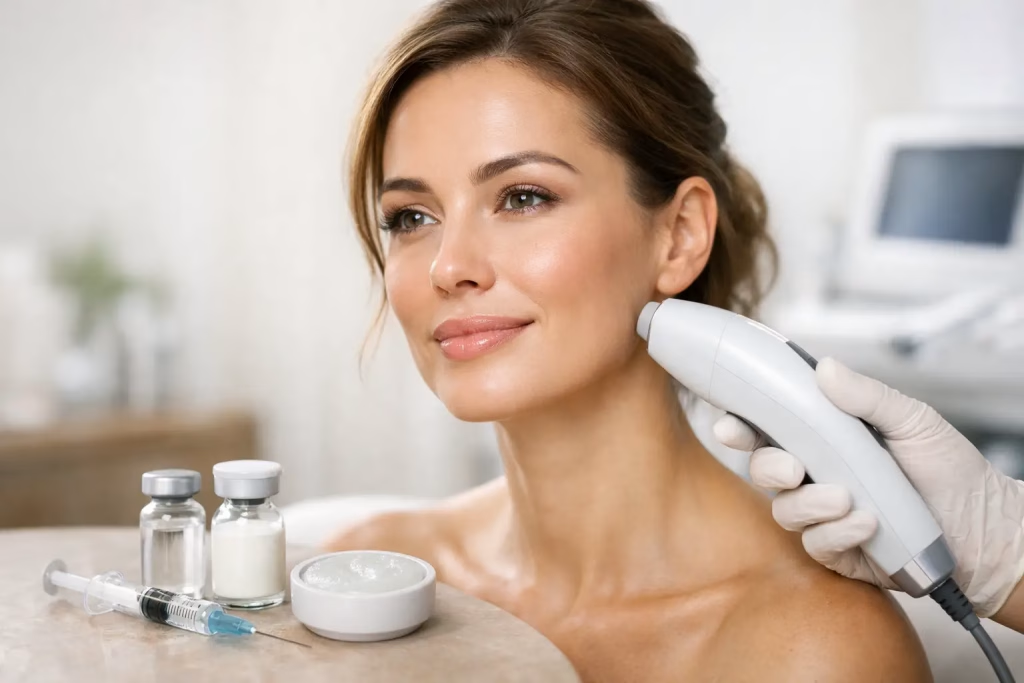
A face can look tired long before it develops deep wrinkles. The change is often structural: soft tissue gradually shifts, cheeks lose support, temples hollow, and the area around the mouth becomes more pronounced. The best options for facial volume address these changes with restraint, respecting the proportions that make your face uniquely yours.
For a refined result, treatment should never begin with a single product or a fixed number of syringes. It begins with understanding where volume has been lost, how your skin is behaving, and whether the concern is truly volume loss, skin laxity, dehydration, or a combination of all three.
Why Facial Volume Changes Over Time
Facial aging is not simply a surface-level concern. With time, the fat pads that create youthful contour can reduce in size or descend, while collagen, elastin, and even bone support gradually diminish. The result may be flatter cheeks, more visible under-eye hollows, deeper nasolabial folds, jowling, or a less defined jawline.
Lifestyle and genetics influence how quickly these changes appear. Weight fluctuations, sun exposure, smoking, stress, and poor sleep can all make facial deflation more apparent. Some people naturally have a leaner facial structure and notice hollowing earlier, while others retain fullness but experience more downward heaviness.
This distinction matters. Adding volume to a face that mainly needs lifting can create an overfilled appearance. Conversely, tightening alone cannot fully restore a cheek that has lost structural support. A thoughtful plan looks at the face in layers and treats only what is needed.
Best Options for Facial Volume: Matching Treatment to the Concern
Hyaluronic acid dermal fillers for immediate refinement
Hyaluronic acid fillers remain one of the most versatile options for restoring targeted facial volume. Hyaluronic acid is a naturally occurring substance that attracts water, allowing a skilled injector to create soft hydration, gentle contour, or firmer structural support depending on the formulation and placement.
These fillers may be used in the cheeks, temples, chin, jawline, lips, and selected folds around the mouth. In experienced hands, the goal is not to make every area prominent. It is to restore visual balance. For example, subtle cheek support can reduce the appearance of lower-face heaviness without directly filling every line.
The primary advantage is precision. Results are visible immediately, although minor swelling can temporarily affect the final look. Another practical benefit is that hyaluronic acid fillers can be dissolved if medically necessary or if the result needs adjustment. Longevity varies by product, area, metabolism, and movement, but many patients enjoy results for several months to well over a year.
There is a trade-off: filler is not a universal solution. Repeatedly filling areas that are already heavy or swollen can blur facial definition. The under-eye region, in particular, requires careful patient selection because puffiness, pigmentation, and skin laxity do not always improve with filler.
Biostimulators for gradual collagen support
Biostimulatory injectables take a different approach. Rather than providing the same immediate gel-based volume as a hyaluronic acid filler, they encourage the body to produce new collagen over time. This can be especially appealing for diffuse hollowing in the temples, cheeks, and lower face, where a gradual, soft restoration may look more harmonious.
Results develop progressively over weeks to months, and treatment often involves a series of sessions. The payoff is a more subtle evolution in facial quality and support, rather than a noticeable change overnight. Depending on the product and individual response, benefits may last longer than conventional filler.
Biostimulators require planning and technical expertise. They are not usually reversible in the same way as hyaluronic acid filler, and they may not be suitable for every area or every patient. For someone seeking a precise correction before an event, a hyaluronic acid filler may be the more predictable choice. For someone looking to improve gradual facial deflation with less emphasis on instant transformation, collagen stimulation can be an elegant option.
Skin boosters for hydration and skin quality
Skin boosters are often confused with volumizing fillers, but they serve a different role. These injectable treatments are designed to improve hydration, luminosity, fine lines, and skin texture rather than sculpt the face or rebuild lost structural volume.
They can be a beautiful complement when the skin looks crepey, dehydrated, or dull, particularly across the cheeks, around the mouth, and in other areas where skin quality affects how rested the face appears. However, a skin booster will not replace a flattened cheek or significantly fill a deep temple hollow. Setting this expectation clearly is central to a satisfying treatment journey.
Energy-based skin tightening for support and definition
When loss of firmness is contributing to facial change, energy-based treatments may be incorporated into a volume-restoration plan. Technologies such as Thermage and Ultherapy are designed to support collagen remodeling at different levels of the skin and underlying tissue, helping improve firmness, lift, and contour over time.
These treatments do not add volume. Their value lies in improving the framework around the volume that remains or has been carefully restored. A patient with early jowling, mild cheek descent, and good natural volume may benefit more from tightening than from substantial filler. Others may achieve the most polished result through a staged combination of conservative filler and collagen-stimulating technology.
Results are gradual, and the degree of lifting depends on skin laxity, age, and individual collagen response. A consultation should be candid about what non-surgical tightening can achieve. It can refine and support, but it cannot reproduce the degree of lift offered by surgery for significant tissue descent.
Fat transfer and surgical approaches for selected cases
For more extensive volume loss, surgical fat transfer may be considered. The procedure uses a patient’s own fat, typically harvested from another area of the body, then processed and placed into areas of facial hollowing. It can provide a natural-feeling result and potentially longer-lasting volume, but it is a surgical procedure with greater downtime, swelling, and variability in fat survival.
Facelift surgery may also be the more appropriate path where severe laxity, pronounced jowling, and neck skin excess are the central concerns. No injectable or device should be presented as a substitute for surgery when the anatomy calls for a surgical solution. A premium consultation is one that recommends the least invasive treatment that still makes sense, not simply the most convenient one.
Aesthetic Planning Is About Proportion, Not More Product
The most natural outcomes tend to come from treating the face as a whole. A cheek may need support, but the temple, chin, jawline, and skin quality can influence whether that correction looks balanced. In many cases, small, intentional adjustments in two or three areas look more refined than a large amount of product placed in one area.
Facial shape, ethnicity, age, and personal preference all deserve consideration. Some patients want discreet rejuvenation that colleagues cannot identify. Others want more defined cheekbones or a sharper profile. Neither preference is wrong, but treatment should be shaped around a clear aesthetic goal and realistic anatomy.
At Kelly Oriental Aesthetic Clinic, a doctor-led assessment can help distinguish between volume loss, skin laxity, and surface concerns before recommending a bespoke combination of injectables, skin boosters, or collagen-stimulating treatments. This prevents a one-size-fits-all approach and keeps results aligned with your natural features.
Safety Matters as Much as the Result
Injectable treatments are medical procedures, not casual beauty appointments. The face contains complex blood vessels, and although uncommon, complications such as vascular occlusion can be serious. Proper anatomical knowledge, sterile technique, appropriate product selection, and prompt management protocols are essential.
Ask who will perform your treatment, what product is being used, why it suits the intended area, and what follow-up care is available. A reputable provider should also discuss common effects such as swelling, bruising, tenderness, and temporary asymmetry. Planning treatment several weeks before an important occasion gives the face time to settle and allows for a review if needed.
Your medical history matters too. Certain skin conditions, autoimmune concerns, active infections, pregnancy, breastfeeding, medications, and previous aesthetic procedures may affect suitability or timing. Honest disclosure helps your doctor create a plan that prioritizes safety alongside visible improvement.
Choosing a Treatment Timeline
If you want immediate yet measured refinement, carefully placed hyaluronic acid filler may be suitable. If your goal is gradual, collagen-led improvement, biostimulators or energy-based treatments may be worth considering. If your concern includes dullness and dehydration, skin boosters can elevate the quality of the skin around any structural work.
Often, the most sophisticated approach is phased. Start by restoring foundational support, then reassess after swelling resolves or collagen has had time to develop. This creates room for adjustment and reduces the temptation to overcorrect in a single appointment.
The right treatment should leave you looking rested, balanced, and recognizably yourself. When facial volume is approached with medical judgment and an eye for proportion, the most beautiful result is not a different face. It is a face that appears quietly renewed.
