
Uncategorized
A Guide to Body Skin Tightening That Works
Oct
Skin laxity rarely appears in just one place or for one reason. You may notice a softer abdomen after pregnancy or weight change, crepey skin above the knees, looseness along the upper arms, or a less-defined jawline and neck. A thoughtful guide to body skin tightening begins by recognizing that each concern has a different cause, depth, and most appropriate treatment path.
For patients who value natural-looking refinement, the goal is not to chase an unrealistic version of tightness. It is to support firmer-looking skin, more elegant contours, and greater confidence through a plan that respects your anatomy, lifestyle, and timeline.
Why Body Skin Begins to Lose Firmness
Skin stays resilient because collagen and elastin provide internal structure, while hyaluronic acid and healthy skin barrier function help it remain supple. From our late 20s onward, collagen renewal gradually slows. Sun exposure, smoking, stress, hormonal changes, and repeated weight fluctuations can accelerate that process.
On the body, laxity may also be influenced by the amount and distribution of underlying fat. This distinction matters. Skin that appears loose due to reduced collagen needs a different approach from an area where stubborn fat, weakened muscle tone, or significant excess skin is the primary concern.
Pregnancy and substantial weight loss deserve especially careful assessment. When skin has been stretched for a prolonged period, non-surgical treatments can improve texture and mild to moderate laxity, but they cannot remove a large amount of excess skin. A credible consultation should be clear about this trade-off from the beginning.
A Guide to Body Skin Tightening: Start With an Assessment
Before selecting a device or treatment, a doctor should assess skin quality, the degree of laxity, body composition, medical history, and your desired outcome. The best treatment is not necessarily the newest or most intensive option. It is the one that addresses what is actually causing the concern.
During a personalized consultation, it is helpful to discuss when you first noticed the change, whether your weight has been stable, and whether you are planning pregnancy or a major fitness change. These details influence both treatment selection and timing. For example, it may be sensible to establish a stable weight before investing in a body-contouring plan.
Photographs can also be useful for tracking progress. Body tightening is often gradual, and consistent images taken in similar lighting make subtle improvements easier to appreciate.
Non-Surgical Treatment Options for Firmer-Looking Skin
Modern aesthetic medicine offers several ways to stimulate collagen without surgical incisions. Results vary by treatment area, baseline skin laxity, and the body’s response to collagen remodeling.
Radiofrequency for Collagen Remodeling
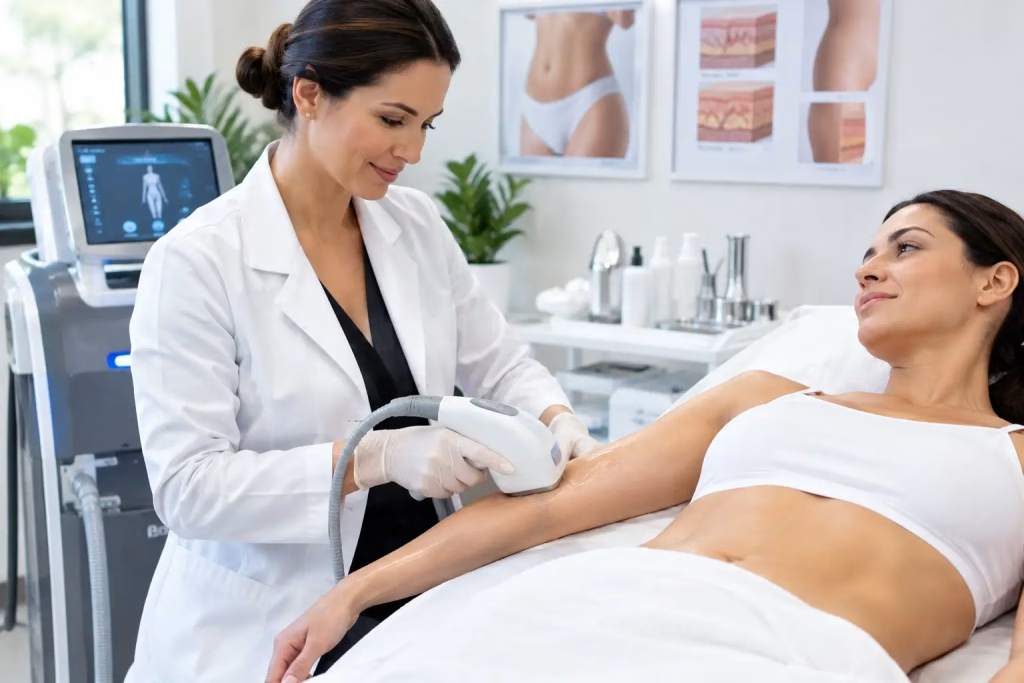
Radiofrequency treatments deliver controlled heat into targeted layers of tissue, encouraging collagen contraction and longer-term renewal. They can be considered for concerns such as mild skin laxity on the abdomen, arms, thighs, buttocks, or knees.
The experience and recovery profile depend on the technology and treatment intensity. Some options involve little to no downtime, while others may leave temporary redness, warmth, or tenderness. Results usually develop progressively over several weeks to months as new collagen forms, rather than appearing fully immediately after treatment.
Ultrasound-Based Skin Tightening
Focused ultrasound can target deeper tissue layers than many surface-level treatments. This makes it a useful consideration for selected areas where support beneath the skin may contribute to a firmer appearance.
Ultrasound-based treatments are not interchangeable with radiofrequency. One may be more suitable than the other depending on the area, thickness of the tissue, and whether the priority is superficial texture, deeper lifting, or a combination of both. In some cases, a staged approach creates a more balanced result.
Microneedling With Radiofrequency
For crepey texture and mild laxity, particularly when skin quality is as much of a concern as contour, radiofrequency microneedling may be recommended. Tiny needles create controlled microchannels while radiofrequency energy is delivered at selected depths. This can support collagen production and improve the appearance of texture over time.
This approach requires appropriate aftercare, including minimizing sun exposure while the skin recovers. Treatment areas may look red or feel sensitive for a short period, so planning around social events is wise.
Injectable and Biostimulatory Approaches
Certain injectable treatments may be considered to support collagen stimulation or improve the appearance of localized skin quality. These are highly technique-dependent and should only be recommended after a careful assessment of the body area, tissue quality, and suitability.
They are not a substitute for surgery in cases of significant excess skin, nor are they a universal solution for every body concern. When used selectively as part of a broader plan, they can complement energy-based treatments.
When Body Contouring and Skin Tightening Work Better Together
A common misconception is that reducing fat will automatically tighten skin. Sometimes it does, particularly when the skin retains good elasticity. In other cases, a sudden reduction in volume can make existing laxity more visible.
This is why body contouring and skin tightening are often planned together rather than treated as separate concerns. If an area has both localized fullness and mild laxity, the sequence of treatments matters. Addressing volume first may clarify how much tightening is needed, while treating laxity first may be preferable in another case.
A measured strategy is particularly important for the lower abdomen, inner thighs, upper arms, and under-chin area. The objective should be proportion and skin quality, not simply making an area smaller.
What Results Can You Realistically Expect?
Non-surgical body skin tightening is best for patients seeking visible but natural refinement. Results tend to be most satisfying when laxity is mild to moderate, weight is stable, and expectations are aligned with what the treatment can achieve.
You may notice early changes from temporary tissue contraction, but collagen remodeling takes time. Many patients see improvement gradually over two to six months, depending on the modality and treatment area. Some plans involve a series of sessions; others are designed as a single treatment followed by review and maintenance.
The longevity of results also depends on aging, sun exposure, weight stability, nutrition, and general health. Treatments can encourage new collagen, but they do not stop the natural aging process. A maintenance strategy can help preserve the quality of your result over time.
Preparing for Treatment and Protecting Your Results
Your provider will give instructions tailored to the chosen procedure. In general, arrive well-hydrated, disclose medications and supplements, and share any history of skin sensitivity, scarring, or implanted medical devices. Certain treatments may not be suitable during pregnancy, while breastfeeding, or for people with particular medical conditions.
After treatment, protect exposed areas from ultraviolet light, avoid excessive heat if advised, and follow the recommended skincare routine. Gentle movement, adequate protein intake, and stable weight can also support your broader body goals. These habits are not replacements for clinical treatment, but they help create the conditions in which your skin can perform at its best.
Choosing Care That Feels Considered
Body concerns can feel deeply personal, which is why the quality of consultation matters as much as the technology itself. Look for a clinic that explains the differences between treatment options, addresses limitations openly, and builds a plan around your priorities rather than a fixed package.
At Kelly Oriental Aesthetic Clinic, a doctor-led assessment can help determine whether your concern is best addressed through collagen-stimulating technology, body contouring, a combination plan, or a surgical referral when that is the more appropriate route. The most refined results are often created through patience, precision, and treatments selected for your body rather than someone else’s.
Firmer-looking skin is not about erasing every sign of change. It is about feeling more at ease in your own silhouette, with care that is tailored, measured, and designed to evolve with you.
