
Uncategorized
Thermage vs Ultherapy Results: What to Expect
Jun
You usually notice the question behind thermage vs ultherapy results at a very specific moment – when your skin still looks good, but no longer looks as firm, defined, or rested as it once did. The jawline softens, the lower face feels heavier, and makeup starts sitting differently around the cheeks or eyes. At that stage, most patients are not looking for dramatic surgery. They want refinement, lift, and a fresher version of themselves that still feels natural.
Thermage and Ultherapy are both established, non-surgical treatments for skin tightening, but they do not create the same kind of result in the same way. That distinction matters. The better choice is rarely the one with the louder reputation. It is the one that matches your anatomy, degree of laxity, comfort level, and expectations for how quickly you want to see change.
Thermage vs Ultherapy results: the core difference
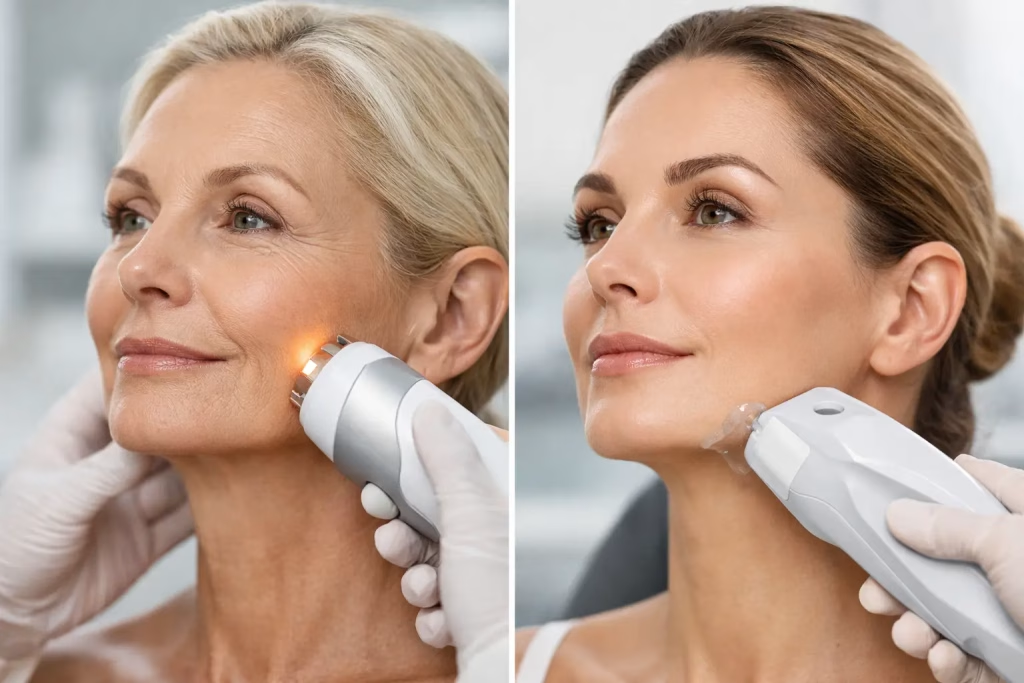
If we strip away the marketing language, the main difference is depth and treatment objective. Thermage uses radiofrequency energy to heat the skin and deeper collagen-rich layers in a broad, volumetric way. It is often chosen for tightening, smoothing, and improving skin quality, especially when the concern is crepey texture, mild to moderate laxity, or early facial aging.
Ultherapy uses focused ultrasound to target deeper structural layers, including the SMAS, which is the same foundational layer addressed in a surgical facelift. Because of that, Ultherapy is typically associated with more lifting, particularly along the brow, under the chin, and around the jawline.
So when patients compare thermage vs ultherapy results, the most useful shorthand is this: Thermage tends to excel at tightening and refining, while Ultherapy is usually better suited for lifting and definition. Of course, real faces are more nuanced than a simple one-line comparison.
How Thermage results usually look
Thermage results tend to be elegant rather than obvious. Skin often looks smoother, firmer, and subtly more compact. Many patients describe it as looking less tired or less slack, rather than looking “done.” This is one reason the treatment remains popular with professionals and anyone who wants visible improvement without attracting attention to the fact that they had a procedure.
The effect is often especially appealing in patients who are beginning to notice looseness around the lower face, jawline, or eye area, but who do not yet have heavy sagging. On the body, Thermage can also be useful where skin texture and mild laxity are the main issue.
Results typically develop gradually over two to six months as collagen remodeling progresses. Some people see a small early tightening effect, but the fuller result is not immediate. The pace suits patients who prefer a discreet transition. The trade-off is that if you are hoping for a clearly visible lift in tissues that have already descended, Thermage may feel too subtle on its own.
Where Thermage tends to shine
Thermage often performs best when the skin is thinning, loosening, or beginning to crinkle, but the facial framework is still relatively supportive. In that setting, it can improve firmness, soften fine lines, and give the face a smoother, more rested finish. Around the eyes, it is often valued for gentle tightening that does not change your expression.
This is why younger patients or those in the earlier stages of aging often do very well with Thermage. The treatment works with what is already there, encouraging the skin to behave more like a firmer version of itself.
How Ultherapy results usually look
Ultherapy results are often described in terms of lift and contour. Patients may notice a cleaner jawline, a little more brow elevation, and better support under the chin. The face can appear less heavy, even if the overall change is still natural. The treatment does not replace surgery, but it can create meaningful structural improvement in the right candidate.
Like Thermage, Ultherapy also relies on collagen stimulation, so the final result takes time. Most patients see progressive improvement over two to three months, with continued refinement after that. The difference is that the visual effect tends to be more about repositioning and support than about surface smoothing.
For patients with mild to moderate sagging, especially in the lower face and neck, Ultherapy may deliver the result they had in mind when they said they wanted to look “lifted.” For patients whose main concern is skin texture, pores, or crepiness, the result may not feel as satisfying if used alone.
Where Ultherapy tends to shine
Ultherapy is often a stronger fit when the issue is not just loose skin, but descent. If the cheeks are starting to weigh down the lower face, or the area under the chin has lost definition, focused ultrasound can be more strategic because it treats deeper structural support.
This makes it attractive for patients who are not ready for surgery but want more than a skin-quality treatment. It can also work well for those who photograph well from the front but notice laxity in profile or under brighter lighting.
Thermage vs Ultherapy results by concern
If your priority is smoother, tighter skin with a refined finish, Thermage often has the edge. It is frequently preferred for early laxity, fine lines, and that slightly crepey or deflated quality that can make the face look fatigued.
If your priority is lift, especially at the brow, jawline, or under-chin area, Ultherapy may be the stronger choice. It addresses the deeper support layer in a way that aligns more closely with those goals.
For many patients, the real answer is not either-or forever. It is sequence and strategy. Some need lift first, then texture refinement. Others have enough support but need the skin itself to look tighter and denser. In a doctor-led setting, the plan should be based on your facial structure, tissue quality, and how aging is showing up on you, not on a one-size-fits-all trend.
Comfort, downtime, and the reality behind the treatment
Results matter most, but patient experience still shapes the decision. Thermage is often perceived as more tolerable, depending on the device settings, treatment area, and individual sensitivity. Ultherapy has a reputation for being less comfortable because ultrasound energy is delivered at greater depths. That does not mean it is unmanageable, but it is an honest part of the conversation.
Downtime for both treatments is generally limited. Most patients return to normal activities quickly. Mild redness, swelling, or tenderness can happen, but these effects are usually temporary. What matters more is social downtime related to expectations. Because results build gradually, neither treatment gives the instant change some patients assume from before-and-after images.
That delayed gratification can be a benefit if you want subtlety. It can be frustrating if you have an event next month and are hoping for a dramatic transformation.
Who is the better candidate for each treatment?
Thermage is often a better fit for patients with mild laxity, textural aging, and skin that needs tightening more than lifting. It can also be appealing for maintenance, especially if you want to stay ahead of visible aging with a polished, low-profile result.
Ultherapy is often better for patients with mild to moderate sagging and enough structural change that they want a visible improvement in contour. If the lower face or neck is your main complaint, and you are realistic about what non-surgical treatment can achieve, it may be the more satisfying option.
Neither treatment is ideal for every face. If there is significant skin excess, heavy jowling, or more advanced laxity, non-surgical energy devices may offer improvement, but not enough to meet expectations. This is where clinical judgment matters. A premium aesthetic experience is not just about offering advanced technology. It is about recommending it responsibly.
Why consultation matters more than the device name
Patients often come in asking for a specific treatment when what they really need is a diagnosis of the problem they see in the mirror. Is it laxity, volume loss, descent, skin thinning, or a combination of all four? The answer changes everything.
An experienced aesthetic doctor will look at facial proportions, skin thickness, collagen quality, and movement patterns before advising a plan. Sometimes the best result comes from Thermage or Ultherapy alone. Sometimes energy-based tightening should be paired with injectables, skin boosters, or other regenerative treatments for a more balanced outcome.
At a clinic such as Kelly Oriental Aesthetic Clinic, that personalized approach is where luxury and medical precision should meet. The technology matters, but thoughtful treatment planning matters more.
So which gives better results?
The better result is the one that matches your concern. Thermage often delivers superior skin tightening and refinement. Ultherapy often delivers superior lift and contour support. If your concern is early aging and subtle looseness, Thermage can be beautifully effective. If your concern is sagging and a softer jawline, Ultherapy may be the more strategic choice.
The most satisfied patients are usually not the ones chasing the most aggressive treatment. They are the ones who understand what each device can realistically do and choose the option that fits their face, timeline, and standard for natural-looking change.
If you are deciding between the two, look beyond brand names and ask a more useful question: do you want tighter skin, more lift, or both? That is often where clarity begins.
