
Uncategorized
Aesthetic Treatment for Fine Lines & Wrinkles
May
Fine lines rarely arrive all at once. They tend to show up quietly – at the corners of the eyes, around the mouth, across the forehead – until one day your skin looks a little less rested than you feel. The right Aesthetic Treatment for Fine Lines & Wrinkles is not about changing your face. It is about restoring freshness, supporting skin quality, and choosing a plan that fits your features, age, and lifestyle.
For many patients, the real question is not whether treatment works. It is which treatment makes sense for their skin now. Fine lines caused by dehydration need a different approach from wrinkles created by repetitive muscle movement, and both are different again from creasing linked to collagen loss or skin laxity. This is why a tailored treatment plan consistently outperforms a one-size-fits-all fix.
Why fine lines and wrinkles develop
Fine lines and wrinkles are part of skin aging, but they do not all form for the same reason. In the early stages, the skin simply starts producing less collagen, elastin, and hyaluronic acid. That means less bounce, less hydration, and a higher tendency for superficial creasing.
Over time, facial expressions also leave their mark. Smiling, squinting, frowning, and raising the brows create repeated movement in the same areas. When skin is youthful, it springs back easily. As support structures weaken, those expression lines begin to linger.
Environmental stress adds another layer. Sun exposure remains one of the biggest contributors to premature aging, especially when it comes to fine crinkling, uneven texture, and thinning skin. Lifestyle factors such as poor sleep, stress, smoking, and dehydration can make lines look more pronounced as well.
That is why effective treatment begins with diagnosis, not trends. A patient in their early 30s with dehydration lines may need skin quality support, while someone in their 40s or 50s may benefit more from collagen stimulation, lifting technologies, or carefully placed injectables.
Aesthetic Treatment for Fine Lines & Wrinkles is not one category
Patients often use the term anti-aging treatment as if it describes a single service. In practice, treating fine lines and wrinkles usually involves one or more of three goals: relaxing overactive facial muscles, improving skin texture and hydration, or tightening and rebuilding structural support.
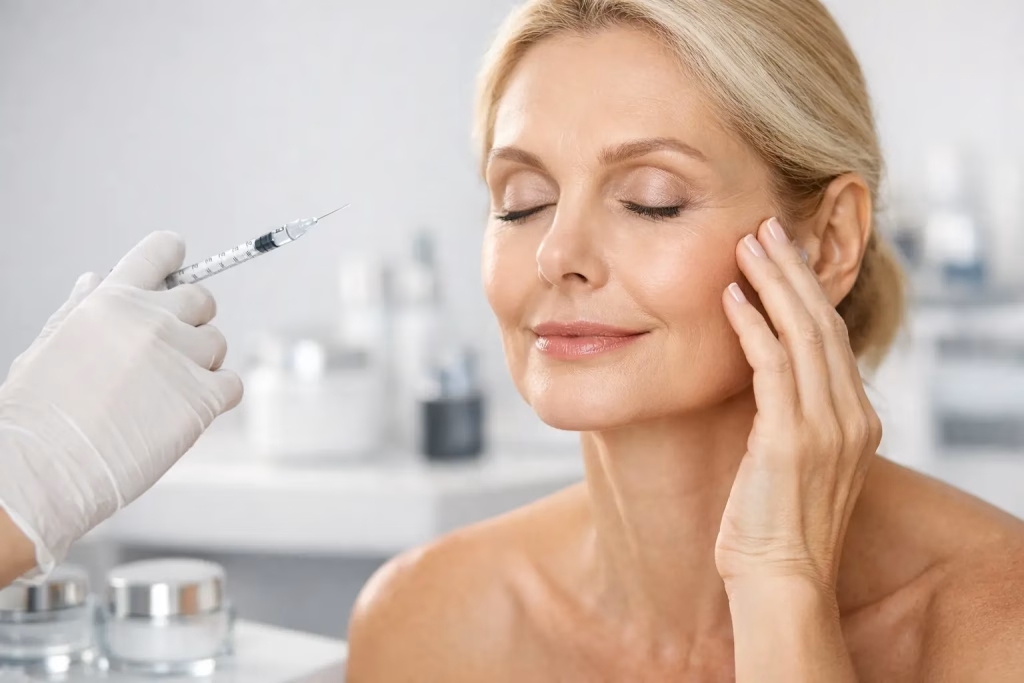
When the concern is dynamic wrinkling, such as forehead lines or crow’s feet that deepen with expression, injectables can help soften movement in a refined way. The goal should be a rested appearance, not a frozen one. Good treatment respects facial character and proportion.
When the issue is crepey texture, dehydration, or early static lines, skin boosters and advanced facial technologies may be more relevant. These options work by improving moisture balance, dermal quality, and surface smoothness, which can make skin look fresher even before deeper wrinkles become a concern.
For patients noticing mild sagging together with wrinkles, energy-based treatments often play an important role. This is where technologies designed to stimulate collagen and support lifting can be especially valuable, because lines often look worse when the skin itself begins to descend.
The main treatment options and where each fits
Injectables remain one of the most established choices for expression-related wrinkles. They are commonly used on the forehead, between the brows, and around the eyes. Results are usually appreciated for their precision and relatively minimal downtime. The trade-off is that they are best for movement-based lines, not for improving overall skin texture on their own.
Skin boosters are often chosen by patients whose skin looks tired, dry, or finely creased even at rest. Rather than altering facial movement, they focus on improving hydration and skin quality from within. This can be particularly appealing for those who want a naturally refreshed look with better luminosity and smoother texture.
Laser and device-based treatments can be useful when wrinkles are accompanied by uneven tone, rough texture, enlarged pores, or superficial sun damage. Certain technologies support rejuvenation by encouraging skin renewal and collagen remodeling. These options may be recommended in a series, depending on the starting point and the desired level of correction.
Radiofrequency and ultrasound-based lifting treatments are typically considered when collagen loss and skin laxity are contributing to an older appearance. Devices such as Thermage or Ultherapy may suit patients who want non-surgical tightening with gradual improvement. The results are not instant in the way fillers or wrinkle-relaxing injectables can be, but they can be meaningful for patients seeking firmer support over time.
Microneedling-based or regenerative technologies may also be introduced when the goal is broader skin revitalization. In the right patient, they can improve texture, stimulate repair, and complement a larger anti-aging strategy.
How doctors decide what you actually need
The most sophisticated plans are rarely built around a single complaint. A patient may come in asking about forehead lines, but a proper assessment often looks at muscle movement, hydration levels, skin thickness, facial volume, and the quality of collagen support beneath the surface.
This matters because treating one issue in isolation can leave the overall result looking incomplete. Softening lines without addressing dehydration may still leave the skin looking fatigued. Improving hydration without supporting laxity may help glow, but not contour. A more elegant result usually comes from matching the treatment to the true cause.
A doctor-led consultation should also account for your routine and tolerance for downtime. Some patients want progressive improvement with little interruption to work or social life. Others are comfortable with a more intensive treatment series if it offers stronger correction. Neither is better. The right plan is the one that aligns with your goals and can be maintained well.
What kind of results are realistic
One of the most common misconceptions in aesthetics is that every wrinkle should disappear. In premium aesthetic care, the aim is usually refinement, not erasure. Skin that looks healthy, smooth, and well-supported tends to read as youthful far more convincingly than skin that looks overtreated.
Results also vary by treatment category. Injectables may produce noticeable softening in selected areas within days. Skin boosters and rejuvenation procedures often reveal improvement more gradually as hydration and collagen response build. Tightening treatments usually require patience, since collagen remodeling happens over weeks to months.
Age is only one factor. Skin condition, sun history, genetics, and consistency with maintenance all influence the outcome. A good practitioner should be honest about what is achievable in one session and when combination therapy is likely to deliver a better result.
Downtime, comfort, and maintenance
For busy professionals, treatment planning often depends as much on recovery as results. Some options involve little to no visible downtime, making them easier to fit into a packed schedule. Others may come with temporary redness, swelling, sensitivity, or mild flaking.
Comfort also varies. Many modern treatments are well-tolerated, especially when performed in a setting that prioritizes patient care and proper technique. Numbing, cooling, and aftercare guidance can make a meaningful difference to the experience.
Maintenance is another important consideration. Fine lines and wrinkles are part of an ongoing aging process, so most treatments are best viewed as part of a long-term skin strategy rather than a permanent one-time fix. The most satisfying journeys often combine periodic in-clinic treatments with disciplined home care and sun protection.
When combination treatment makes more sense
If your skin concerns include more than one sign of aging, combination treatment is often the most efficient route. A patient with crow’s feet, mild cheek laxity, and dehydration lines may benefit from injectables for movement, a collagen-stimulating device for firmness, and skin-boosting treatments for texture.
This layered approach can produce a more polished and balanced result because each modality solves a different problem. It also allows treatment to stay natural. Instead of over-relying on one intervention, the face is supported more intelligently.
At a clinic such as Kelly Oriental Aesthetic Clinic, this type of bespoke planning is often what distinguishes a premium experience from a transactional one. The goal is not simply to offer many devices, but to curate them thoughtfully around the individual.
How to choose the right clinic for wrinkle treatment
When seeking treatment for fine lines and wrinkles, credentials and judgment matter as much as technology. Advanced devices and injectables can be excellent tools, but results depend on proper assessment, technique, and restraint.
Look for a clinic that offers doctor consultation, individualized planning, and clear communication about expected results. A strong provider should explain why a treatment is suitable, what alternatives exist, and where the limitations are. If every patient seems to receive the same recommendation, that is usually a sign that the treatment plan is being led by inventory rather than anatomy.
Environment matters too, especially for patients who value privacy, comfort, and continuity of care. A refined clinical setting with attentive follow-up often makes the experience feel calmer and more confidence-building. For many discerning patients, that level of care is not an extra. It is part of choosing wisely.
The best time to treat fine lines is often earlier than people think, when small changes can still be addressed with subtle intervention. But even more important than timing is choosing a plan that respects your face, your pace, and the way you want to look when you walk back out into the world.
