
Uncategorized
Ultherapy Review: Is It Worth It?
If your jawline looks softer in photos, your brows sit a little lower than they used to, or your neck has started to lose definition, an ultherapy review is usually not about curiosity alone. It is about one question: can a non-surgical treatment create a visible lift without making you look overdone?
Ultherapy sits in a very specific lane. It is not a filler treatment, not a laser, and not a quick glow facial. It uses focused ultrasound energy to target deeper structural layers under the skin, including the same foundational plane often addressed in surgical lifting. That distinction matters, because Ultherapy is designed for firmness and support, not volume or surface texture. When patients are chosen well, the results can feel elegant and natural. When expectations are off, disappointment tends to follow.
Ultherapy review: what the treatment actually does
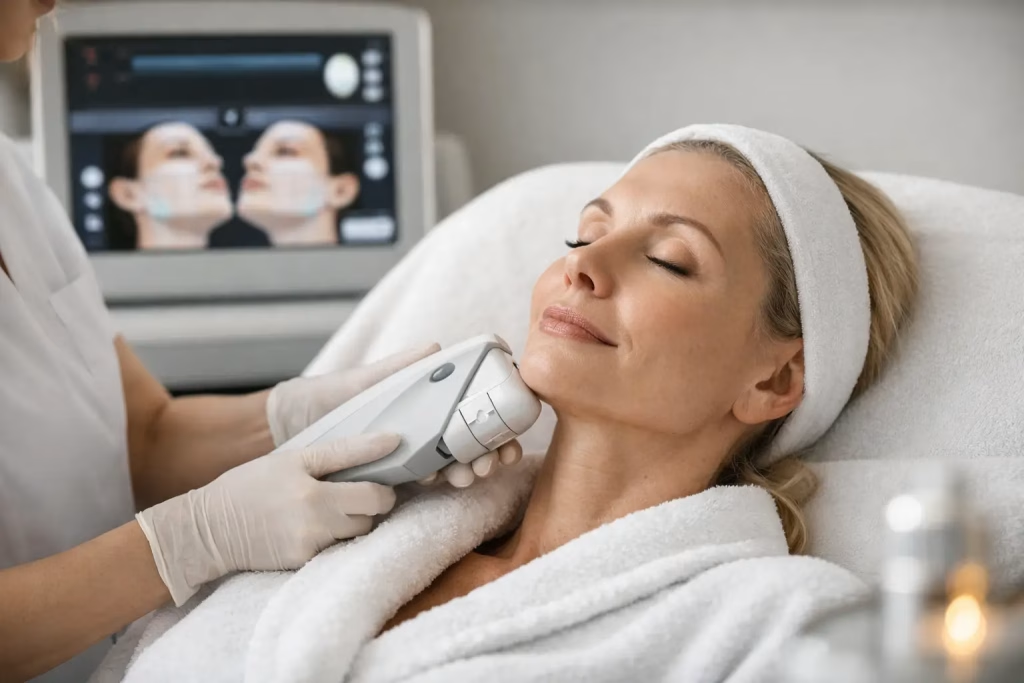
At its core, Ultherapy is a collagen-stimulating skin tightening treatment. It delivers microfocused ultrasound energy at precise depths beneath the skin to trigger a wound-healing response. That response encourages new collagen and elastin formation over time.
What most patients want to know is simpler than the science: will it lift? The honest answer is yes, but within limits. Ultherapy can improve mild to moderate skin laxity along the brow, lower face, jawline, under-chin area, and neck. It can also soften crepey skin on the chest in some cases. The effect is typically a refined lift rather than a dramatic transformation.
That subtlety is exactly why many people like it. The result tends to read as fresher, firmer, and more rested, not obviously treated. For professionals and socially active adults who want discretion, that is often the appeal.
Who gets the best results
The strongest outcomes usually happen in patients with early to moderate laxity. Think of skin that has started to descend, but still has enough elasticity to respond well. If you are in your 30s to 50s and noticing softening around the jawline, mild jowling, a heavier lower face, or a less defined neck, Ultherapy may be a strong fit.
It is less ideal for someone with significant skin excess, very heavy tissue, or expectations closer to a facelift. In those cases, the treatment may still help, but the change can feel too modest relative to the investment.
This is where an experienced medical consultation matters. A thoughtful provider should assess facial anatomy, skin quality, degree of laxity, and whether collagen stimulation alone is enough. Sometimes the best plan is not Ultherapy alone, but a combination approach with injectables, biostimulatory treatments, radiofrequency, or skin-focused resurfacing.
What an honest Ultherapy review should say about results
Most positive reviews share a similar theme: the improvement looks natural and continues to build. You usually do not leave with an instant sculpted jawline. Some patients notice a small early tightening effect, but the more meaningful change develops gradually over two to three months, with continued improvement for up to six months.
That slower timeline can be either reassuring or frustrating, depending on your priorities. If you want immediate transformation before a major event next week, this is probably not the right choice. If you prefer a quiet, progressive lift that does not invite comments or speculation, it makes far more sense.
In well-selected patients, the results often show up as better definition at the jawline, a slightly lifted brow, less heaviness under the chin, and a firmer-looking neck. The skin may also appear denser and more supported. What it does not do particularly well is replace volume loss, erase deep folds, or address pigmentation and enlarged pores. Those concerns require other modalities.
Does Ultherapy hurt?
This is one of the most debated parts of any ultherapy review, and it deserves a candid answer. It can be uncomfortable. The sensation is often described as brief pulses of heat, tingling, or deep zapping under the skin. Some areas, especially along the jawline and near bone, tend to feel more intense than others.
That said, the experience varies widely. Energy settings, treatment technique, your pain tolerance, and whether comfort measures are used all make a difference. A skilled provider will usually adjust the treatment thoughtfully rather than taking a one-size-fits-all approach.
Discomfort is temporary, but it should never be dismissed. Patients generally tolerate it well when they know what to expect and when the treatment is performed in a medically supervised setting where safety and patient comfort are taken seriously.
Downtime, recovery, and what you may notice after
One reason Ultherapy remains popular is that recovery is relatively light. Most people return to work or social plans the same day. You may have mild redness, tenderness, slight swelling, or a temporary tingling sensation. Some patients feel sore to the touch for a few days, particularly along the lower face or neck.
Bruising can happen, though it is less common. Temporary numbness or altered sensation is also possible and usually resolves. Serious complications are uncommon when the treatment is performed properly, but this is still an energy-based medical procedure, not a spa service. Device quality, operator skill, and treatment planning matter.
Is Ultherapy worth the cost?
This is where the review often becomes more nuanced. Ultherapy is usually positioned as a premium treatment, and for good reason. The technology is advanced, the treatment is technique-sensitive, and the results depend heavily on proper patient selection. It is not inexpensive.
Whether it is worth it depends on what you are comparing it to. If your alternative is surgery and you are not ready for surgery, Ultherapy can be a compelling middle ground. If your alternative is a lower-cost skin tightening treatment, the question becomes whether you value precision, proven lifting capability, and a more established treatment profile.
For patients seeking a natural lift with little downtime, the value can be excellent. For those expecting dramatic contour changes from a single session, it may feel underwhelming. The cost makes the most sense when the indication is right and the treatment plan is realistic.
Ultherapy review versus other tightening treatments
Not all tightening treatments work at the same depth or for the same concern. Ultherapy is often chosen when lifting is the priority, especially at deeper structural levels. Radiofrequency-based treatments may be preferred when the goal is more generalized skin tightening, textural refinement, or a different comfort profile.
Thermage, for example, is also a respected non-surgical tightening treatment, but it works differently and often appeals to patients focused on broad collagen remodeling rather than targeted ultrasound lifting. Lasers can improve surface quality, pigmentation, and texture, but they do not substitute for deeper tissue support. Injectables can restore contour and soften lines, but they do not tighten loose skin in the same way.
This is why the best aesthetic plans are often bespoke. One treatment may sharpen the jawline, another may restore cheek support, and another may improve skin tone and radiance. Thoughtful layering often produces the most elegant result.
How to make your Ultherapy review a positive one
The biggest predictor of satisfaction is not hype. It is alignment. You want the right indication, the right provider, and the right expectations.
A quality consultation should explain what Ultherapy can improve, what it cannot, how many treatment lines are appropriate, what level of result is realistic, and whether you may benefit more from another approach. If a clinic promises a surgical-level lift from a single non-surgical session, caution is warranted.
It also helps to think beyond the treatment day. Collagen stimulation works best as part of a broader longevity-minded strategy. Skin quality, hydration, sun protection, weight stability, and maintenance treatments all influence how long your result remains visible.
In a doctor-led aesthetic setting such as Kelly Oriental Aesthetic Clinic, the advantage is not simply access to a device. It is the ability to place Ultherapy within a refined, personalized plan that respects both facial anatomy and the kind of result sophisticated patients actually want – visible, polished, and believable.
Final thoughts on this ultherapy review
Ultherapy is not a miracle treatment, and that is precisely why it has stayed relevant. It offers something rarer than hype: measured, natural-looking lift for the right patient. If you want discreet rejuvenation, minimal downtime, and a result that unfolds with quiet confidence, it is well worth a conversation with an experienced aesthetic doctor.
