
Uncategorized
Acne Scar Treatment Examples That Match Your Scars
Oct
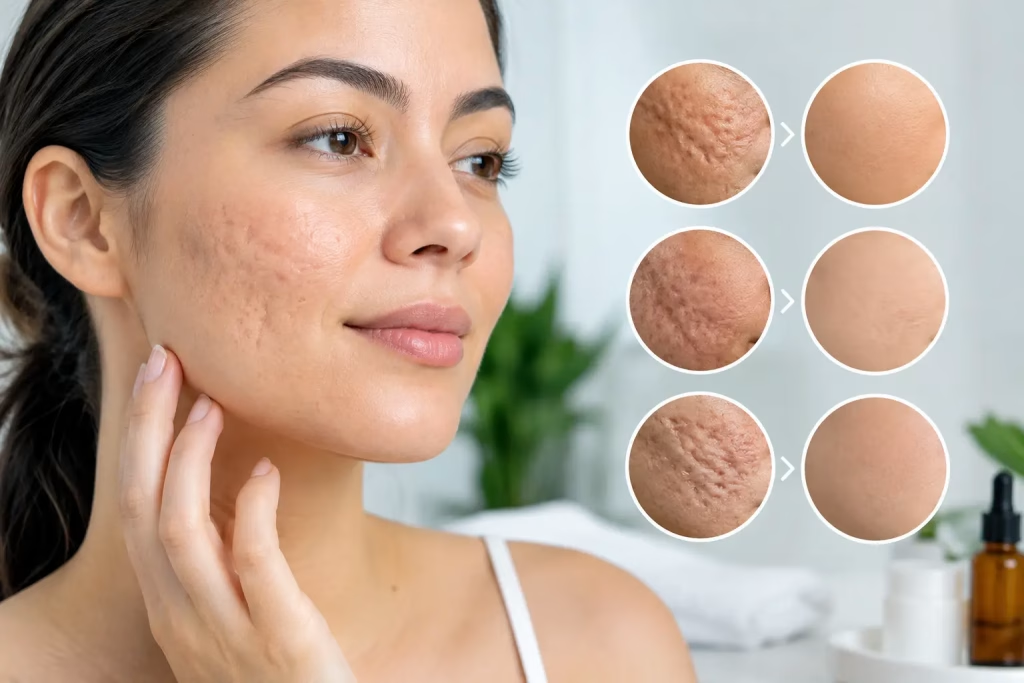
A scar that appears shallow in the bathroom mirror can look markedly different under office lighting or in a close-up photograph. That is why meaningful acne scar treatment examples begin with one essential distinction: acne scars are not all the same, and the most refined results rarely come from a single, one-size-fits-all procedure.
For many patients, acne has long settled, yet textural changes, uneven contours, and lingering marks continue to affect how confidently they feel bare-faced. A personalized plan considers the shape and depth of each scar, active breakouts, skin tone, downtime preferences, and the level of improvement that feels worthwhile to you.
Acne Scar Treatment Examples by Scar Type
Acne scarring broadly falls into two categories. Atrophic scars are indented scars caused by collagen loss, while raised scars develop when the skin produces excess collagen during healing. Within those categories, the details matter.
- Rolling scars create soft, wave-like shadows and are often tethered beneath the skin.
- Boxcar scars have broader, more defined edges and may be shallow or deep.
- Icepick scars are narrow and deep, often resembling tiny punctures.
- Hypertrophic scars and keloids are raised, firm scars that need a different strategy from depressed scars.
Post-inflammatory hyperpigmentation is also commonly mistaken for scarring. These flat brown, red, or purple marks may benefit from a different treatment pathway than textural scars. During a doctor-led assessment, identifying the difference prevents patients from investing in a procedure that does not address their primary concern.
Example 1: RF Microneedling for Diffuse Texture and Pores
Radiofrequency microneedling is often considered when the skin has widespread fine textural irregularities, enlarged pores, and shallow rolling or boxcar scars. Fine needles create controlled microchannels while radiofrequency energy is delivered beneath the surface, supporting collagen remodeling at targeted depths.
Sylfirm X is one example of an RF microneedling technology that may be incorporated into an acne scar plan. It can be particularly appealing for patients seeking gradual refinement with relatively manageable downtime. Skin may look red and feel warm immediately after treatment, followed by a few days of mild dryness or roughness.
This approach is not designed to erase deep icepick scars in one session. It is often more effective as part of a series, sometimes complemented by a more targeted procedure for scars with sharper edges or deeper tethering. Results develop progressively because collagen remodeling takes time.
Example 2: Pico Laser for Texture and Residual Discoloration
Pico laser treatments can be a thoughtful option when acne scarring is accompanied by uneven tone, residual pigmentation, or a dull-looking complexion. Depending on the treatment settings and handpiece used, laser energy may create controlled microscopic treatment zones that encourage skin renewal while also addressing pigment.
For a patient with shallow boxcar scars and post-acne marks, fractional pico laser may be recommended as part of a broader corrective course. The goal is not simply to brighten the skin temporarily, but to gradually improve how light reflects across uneven areas.
Laser selection requires care, particularly for skin prone to post-inflammatory hyperpigmentation. Energy settings, pre- and post-treatment skincare, sun protection, and the timing of treatments all influence safety and outcomes. A premium treatment plan should never treat skin tone as an afterthought.
Example 3: Subcision for Tethered Rolling Scars
Some rolling scars remain visible because fibrous bands beneath the skin pull the surface downward. In these cases, resurfacing alone may not create the improvement a patient expects. Subcision is a minimally invasive technique in which a doctor uses a fine instrument to release those tethering bands under the skin.
A patient may notice that certain scars look more pronounced when they smile, turn their head, or stand near a window. Those dynamic shadows can be a clue that tethering is involved. Once the scar is released, the skin may sit more evenly, allowing later collagen-stimulating treatments to work on a smoother foundation.
Bruising and swelling are possible after subcision, so it may be less convenient before an important event. Yet for well-selected rolling scars, it can be a pivotal step in a treatment journey. Some patients may also benefit from a carefully placed filler to support a released depression, although this depends on the scar pattern and facial anatomy.
Example 4: TCA CROSS for Deep Icepick Scars
TCA CROSS is a targeted chemical reconstruction technique used for narrow, deep scars, particularly icepick scars. Rather than applying a peel broadly across the face, a clinician places a small amount of trichloroacetic acid directly into the scar. This initiates a controlled healing response intended to improve the scar’s depth over time.
The treatment is precise, which is its advantage and its limitation. It can address scars that are too narrow for broader resurfacing to treat efficiently, but it will not correct every uneven area of the face. Temporary frosting at the treatment point, followed by small scabs, is expected. Patients should not pick or prematurely exfoliate these areas during recovery.
For someone with a mix of icepick and rolling scars, TCA CROSS may be performed alongside other modalities over several appointments. This layered approach is often more realistic than asking one treatment to solve multiple scar types at once.
Example 5: Injections for Raised Acne Scars
Raised scars demand restraint and clinical precision. Hypertrophic scars and keloids are not treated by trying to stimulate more collagen. Instead, a doctor may consider carefully administered corticosteroid injections to soften and flatten the scar. Other approaches may be considered depending on the scar’s location, thickness, symptoms, and tendency to recur.
This is a category where self-treatment and aggressive exfoliation can do more harm than good. Raised scars can be biologically active, and treatment planning should prioritize control, comfort, and a measured approach rather than speed.
Why Combination Plans Often Look More Natural
The most compelling acne scar treatment examples are often combination cases. A patient may begin with subcision for tethered scars, use TCA CROSS for a handful of deep icepick scars, then complete RF microneedling or pico laser sessions to improve overall texture and tone. Each treatment has a distinct role.
This sequencing matters. Releasing a tethered scar before resurfacing, for instance, may allow later treatments to produce a more even result. Likewise, settling active acne before investing in scar revision helps protect the progress being made. A good plan respects both the biology of healing and the practical rhythm of a patient’s lifestyle.
At Kelly Oriental Aesthetic Clinic, acne scar care is approached as a bespoke skin journey rather than a preset package. Doctor consultation helps determine which technologies and techniques suit the scar profile in front of you, while a calm, considered setting makes a corrective treatment course feel easier to maintain.
What to Expect From the Timeline
Scar revision is a process, not an overnight correction. Some improvement may become visible after the skin settles, but collagen-based changes typically continue to evolve for weeks or months. The number of sessions depends on scar severity, chosen modalities, skin response, and whether active acne or pigmentation needs parallel care.
The aim should be meaningful refinement, not the unrealistic promise of poreless, perfectly uniform skin. The most elegant outcomes preserve natural movement and character while making scars less visually dominant. With the right diagnosis and a thoughtfully staged plan, your skin can begin to tell a softer story than the acne that came before it.
